The Power of Art: Cultivating Creativity and Critical Skills in Student Development


Walk into any classroom where students are painting, sketching, sculpting, or composing, and you'll notice something different in the air. Shoulders relax. Eyes focus. Ideas start to flow without the pressure of a single "right answer." This is the quiet power of art in education, and it deserves far more attention than it usually gets.
For years, art has been treated as an extracurricular nice-to-have, easily trimmed when school budgets tighten, or academic schedules get crowded. But a growing body of educational research, along with decades of classroom experience, tells a different story. Art isn't a break from real learning; it's a vital part of it.
Art as a Training Ground for Creativity
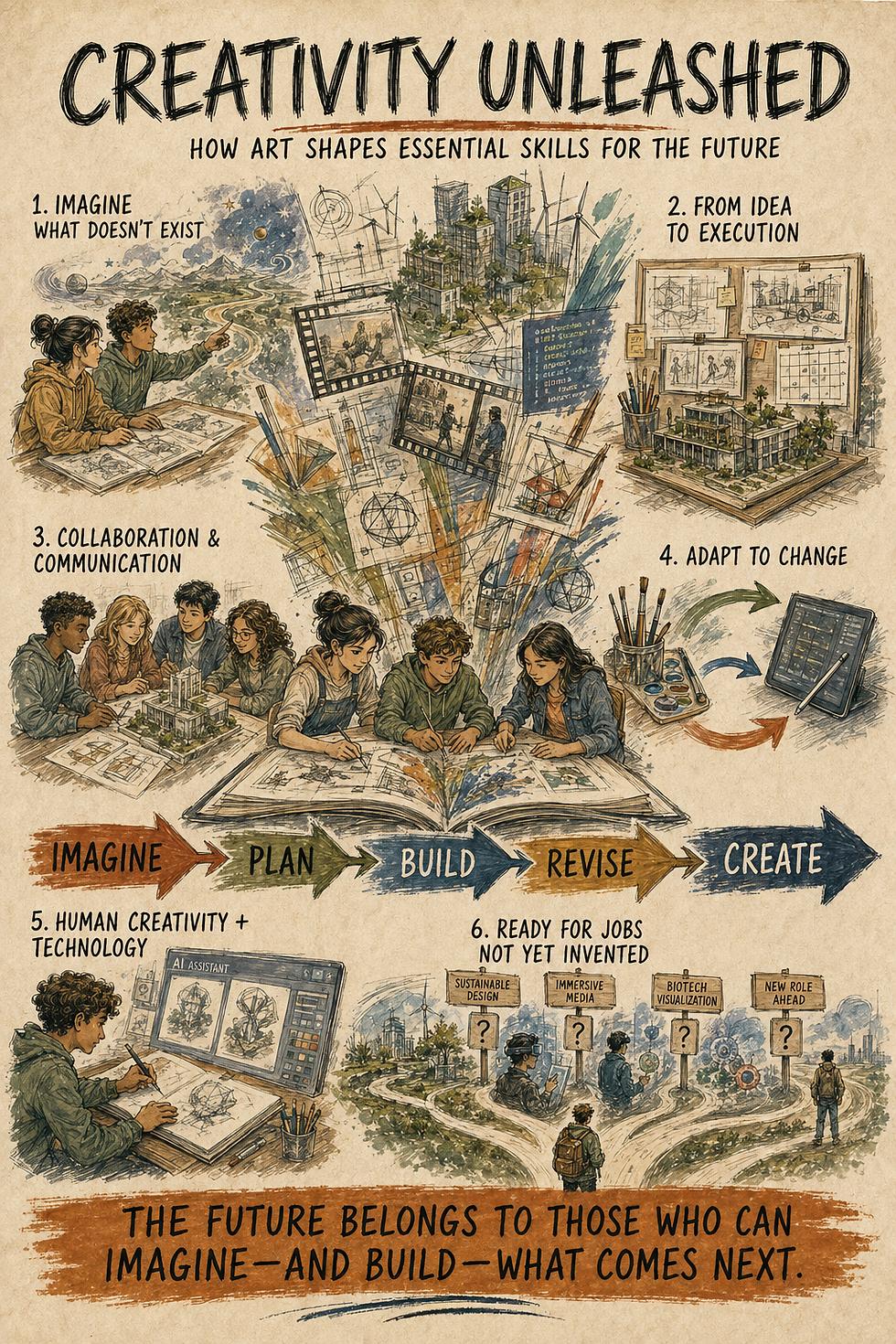
Creativity isn't a trait some students are born with, and others aren't. It's a skill, and like any skill, it grows with practice. Art gives students a low-stakes, high-engagement space to practice generating ideas, taking risks, and tolerating uncertainty, all without the fear of a "wrong" answer that often shuts down thinking in more rigid subjects.
When a student stares at a blank canvas or an empty page, they're forced to make choices: what to include, what to leave out, what story to tell. This process of open-ended decision-making builds the same cognitive muscles they'll later use to solve unfamiliar problems, whether in a science lab, a business plan, or everyday life.
Sharpening Critical Thinking Through Observation and Interpretation
Art doesn't just ask students to create; it asks them to look closely and think deeply. Analyzing a painting, a film, or a piece of music requires students to notice details, consider context, and form an interpretation they can defend. This is critical thinking in action.
Discussing a work of art with classmates often surfaces multiple valid interpretations, teaching students that complex questions rarely have a single correct answer. That comfort with ambiguity and multiple perspectives is exactly the thinking students need for research, debate, and real-world decision-making.
Building Emotional Intelligence and Resilience
Art also offers something academic subjects rarely do: a direct outlet for emotional expression. Students process feelings, frustration, joy, confusion, hope- through color, form, and story in ways that words alone sometimes can't capture. This builds emotional vocabulary and self-awareness.
Just as importantly, art teaches resilience. A sculpture that cracks, a drawing that doesn't turn out as planned, a musical piece that falls apart mid-rehearsal- these are everyday occurrences in an art room. Students learn to revise, adapt, and try again, developing a growth mindset that transfers well beyond the studio.
Connecting Art to Broader Academic Success
Far from distracting students from "core" subjects, engagement with the arts tends to support them. Students who study art often show improved focus, better spatial reasoning, and stronger collaboration skills, all of which carry over into math, science, and language learning. Art also gives students who struggle with traditional testing formats a chance to demonstrate understanding and mastery in a different way, which can be a powerful confidence builder.
Making Space for Art in Every Classroom
Supporting art in education doesn't require a fully equipped studio or a dedicated art teacher for every school. Small, consistent opportunities matter:
Weaving visual projects into history or science lessons
Encouraging journaling, doodling, or sketchnotes as a way to process ideas
Making time for open-ended creative projects without a rigid rubric
Inviting students to explain and defend their creative choices, building both confidence and critical thinking
Conclusion
Art is not a luxury bolted onto "real" education; it's a foundation for it. It teaches students to think flexibly, observe, express themselves honestly, and recover from setbacks with resilience. In cultivating these skills, art doesn't just create better artists. It helps create better thinkers, better problem-solvers, and better-prepared young people ready to navigate a complex world.


Comments