Art Education: A Pathway to Lifelong Learning and Professional Success


When people picture the payoff of an art education, they often imagine one thing: a career as a painter, illustrator, or designer. That picture is far too small. Art education doesn't just prepare a narrow slice of students for creative careers; it builds a mindset and a skill set that serve people across every profession and every stage of life.
Learning How to Learn
At its core, art education teaches something more valuable than any single technique: how to learn. Every new medium, every unfamiliar project, asks students to experiment, fail, adjust, and try again. This cycle- try, observe, revise, try again is the same cycle behind almost all deep learning, whether someone is mastering a musical instrument, debugging code, or picking up a new language in their 40s.
Because art rarely hands students a fixed formula, it trains them to become comfortable self-directed learners. That comfort with figuring things out independently is exactly what lifelong learning requires, especially in a world where the specific tools and technologies of any profession keep changing.
The Professional Skills Hidden Inside Art Class
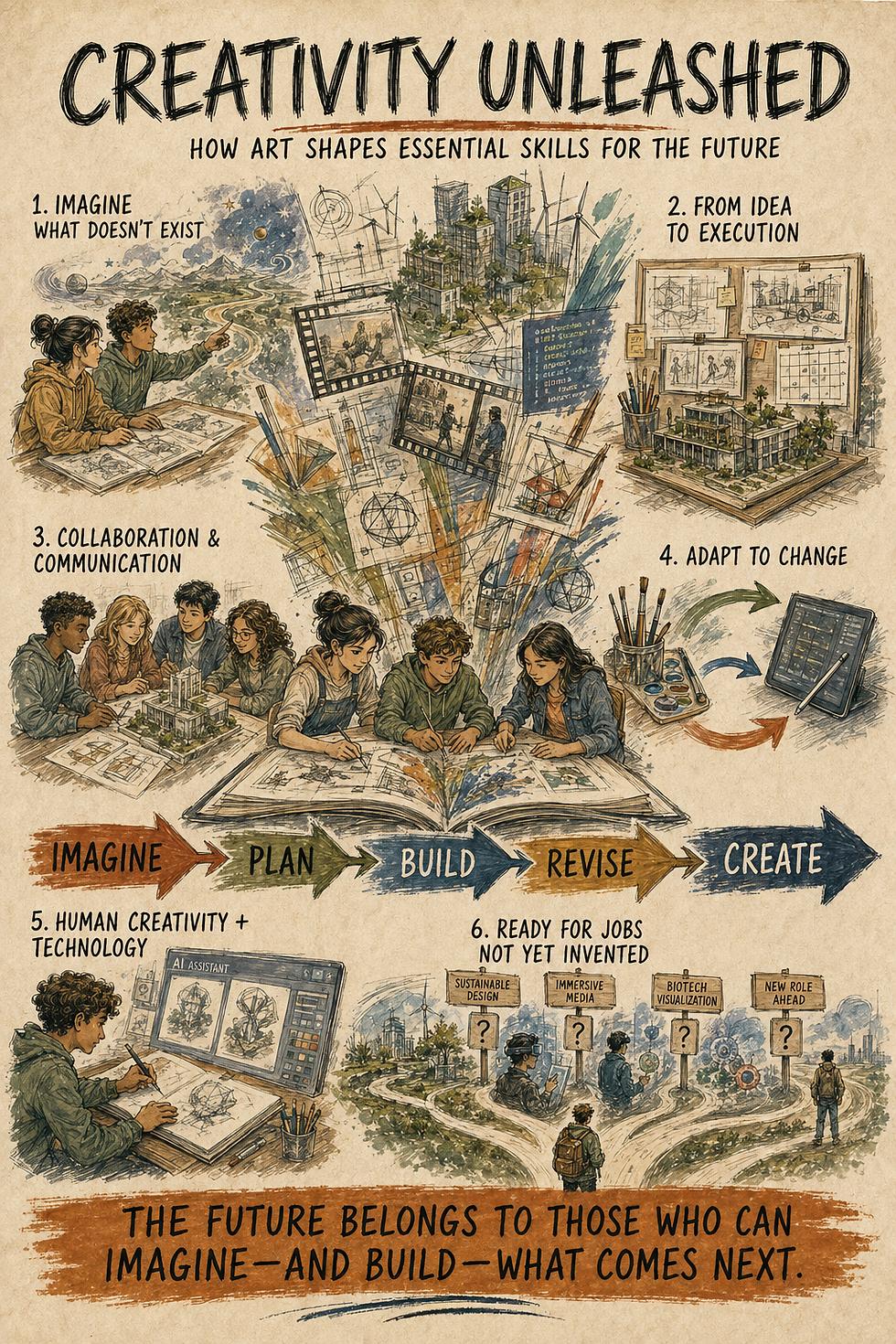
Employers across industries consistently list the same skills as most valuable: creative problem-solving, communication, adaptability, and the ability to give and receive feedback. Art education builds all four, often without students even realizing it.
Creative problem-solving develops naturally when students face open-ended projects with no single correct answer.
Communication improves as students learn to explain their creative choices and intentions to others.
Adaptability grows every time a project doesn't go as planned, and a student has to pivot.
Feedback skills are practiced constantly in critiques, where students learn to offer constructive input and to receive criticism of their own work without taking it personally.
These aren't "soft" extras; they're the exact skills that separate competent employees from exceptional ones, in fields ranging from engineering to marketing to healthcare.
Art as a Bridge to Innovation-Driven Careers
Some of the most in-demand careers today live at the intersection of creativity and technical skill: UX and product design, architecture, game development, film and animation, marketing and branding, and increasingly, fields like data visualization and AI-assisted design. Art education gives students a head start in exactly this kind of interdisciplinary thinking, teaching them to see technical problems through a creative lens and creative problems through a structured, technical one.
Even in fields that seem far removed from art, the habits of mind it builds by observing, considering multiple perspectives, and communicating visually translate directly into stronger presentations, better product design instincts, and more persuasive storytelling in a boardroom.
A Foundation for a Lifetime, Not Just a Semester
Perhaps the most underappreciated benefit of art education is durability. Unlike some technical skills that can become outdated, the habits built through art curiosity, resilience, self-expression, and critical observation stay relevant across an entire career and life. Someone who studied art in school often carries these habits into hobbies, parenting, community involvement, and personal reinvention decades later.
Conclusion
Art education isn't a detour from "practical" learning; it's one of the most practical investments a student can make. It builds the adaptability, creativity, and communication skills that today's careers demand, while also cultivating a lifelong appetite for learning itself. Whether a student grows up to be an artist, an engineer, a doctor, or an entrepreneur, the lessons learned in an art classroom stay with them, quietly shaping how they think, solve problems, and grow for the rest of their lives.


Comments