Creativity Unleashed: How Art Shapes Essential Skills for the Future

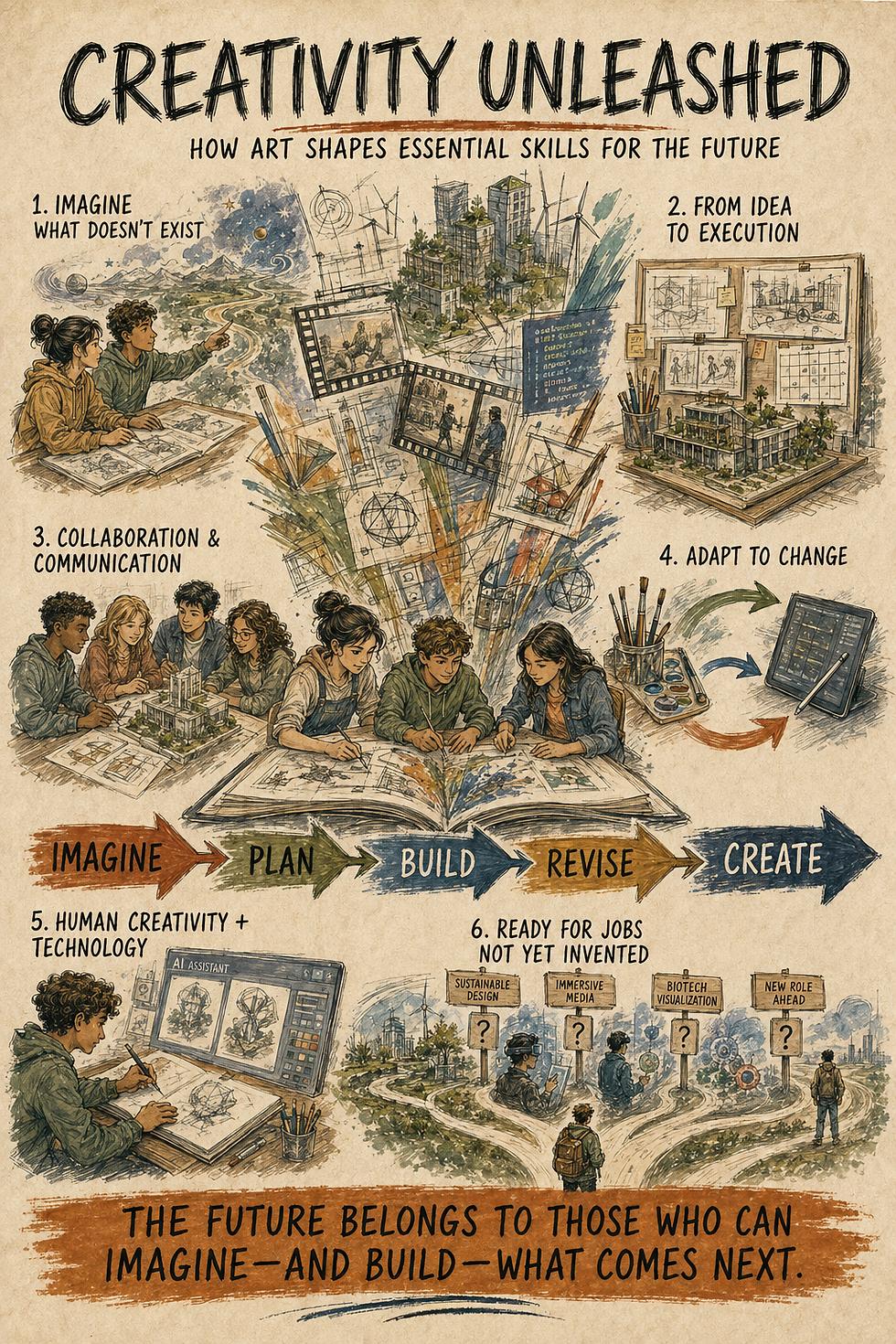
The future of work is uncertain in almost every way except one: it will demand creativity. As automation and AI take over more routine, rule-based tasks, the skills that remain distinctly human are imagination, original thinking, and the ability to connect unrelated ideas are becoming the most valuable currency in the job market. Art education is one of the few places where these skills are deliberately, systematically trained.
Why Creativity Is No Longer Optional
For most of the industrial era, success meant following instructions accurately and efficiently. That world is fading. Today's most pressing challenges, from climate change to public health to rapidly shifting technology, don't come with instruction manuals. They require people who can imagine solutions that don't yet exist.
Art education trains exactly this capacity. Every time a student is handed a blank page, an empty canvas, or an open-ended prompt, they practice generating something from nothing. That repeated practice of imagining possibilities is not abstract or "soft". It's a direct rehearsal for the kind of thinking tomorrow's problems will require.
From Imagination to Execution
Creativity without follow-through is just daydreaming. What makes art education so powerful is that it pairs imagination with execution. Students don't just think of ideas; they have to plan, build, revise, and finish. A mural doesn't paint itself. A short film needs a script, a shoot schedule, and hours of editing.
This combination of imaginative thinking and disciplined execution is precisely what innovation requires in any field. Entrepreneurs, engineers, and designers all need to move from "what if" to "here's how," and art education gives students structured practice doing exactly that.
Collaboration and Communication in a Connected World
Future careers will rarely reward people who can only work alone. Group art projects, ensemble performances, and collaborative design work all teach students to build on each other's ideas, negotiate creative differences, and communicate visually and verbally about abstract concepts. These are the same skills needed to work effectively on diverse, cross-functional teams, increasingly the norm in modern workplaces.
Adaptability in the Face of Constant Change
If there's one certainty about the future, it's that it will keep changing. Tools, technologies, and entire industries will rise and fall faster than ever before. Art education builds adaptability as a habit, not just a buzzword. Students constantly work with new materials, new techniques, and unexpected outcomes, learning to adjust their approach rather than rigidly sticking to a single plan.
This flexibility, the willingness to abandon what isn't working and try a different approach, is exactly what will separate people who thrive amid rapid change from those who struggle with it.
Preparing Students for Jobs That Don't Exist Yet
Many of today's students will eventually work in roles that haven't been invented yet. No curriculum can predict the specific technical skills those jobs will require. What educators can do is build the underlying capacities for creativity, critical thinking, adaptability, and collaboration that will let students learn whatever comes next.
Art education does this better than almost any other discipline, precisely because it isn't tied to a single fixed body of knowledge. It teaches a way of thinking and approaching problems that remains useful no matter how the specific landscape shifts.
Conclusion
The future will belong to those who can imagine what doesn't yet exist and figure out how to build it. Art education, often undervalued as a "creative outlet," is in fact one of the most future-proof forms of learning available. By nurturing creativity alongside discipline, collaboration, and adaptability, art doesn't just shape better artists; it shapes the kind of thinkers the future will need most.


Comments